
How a Website Helps Chicago Contractors Get More Leads
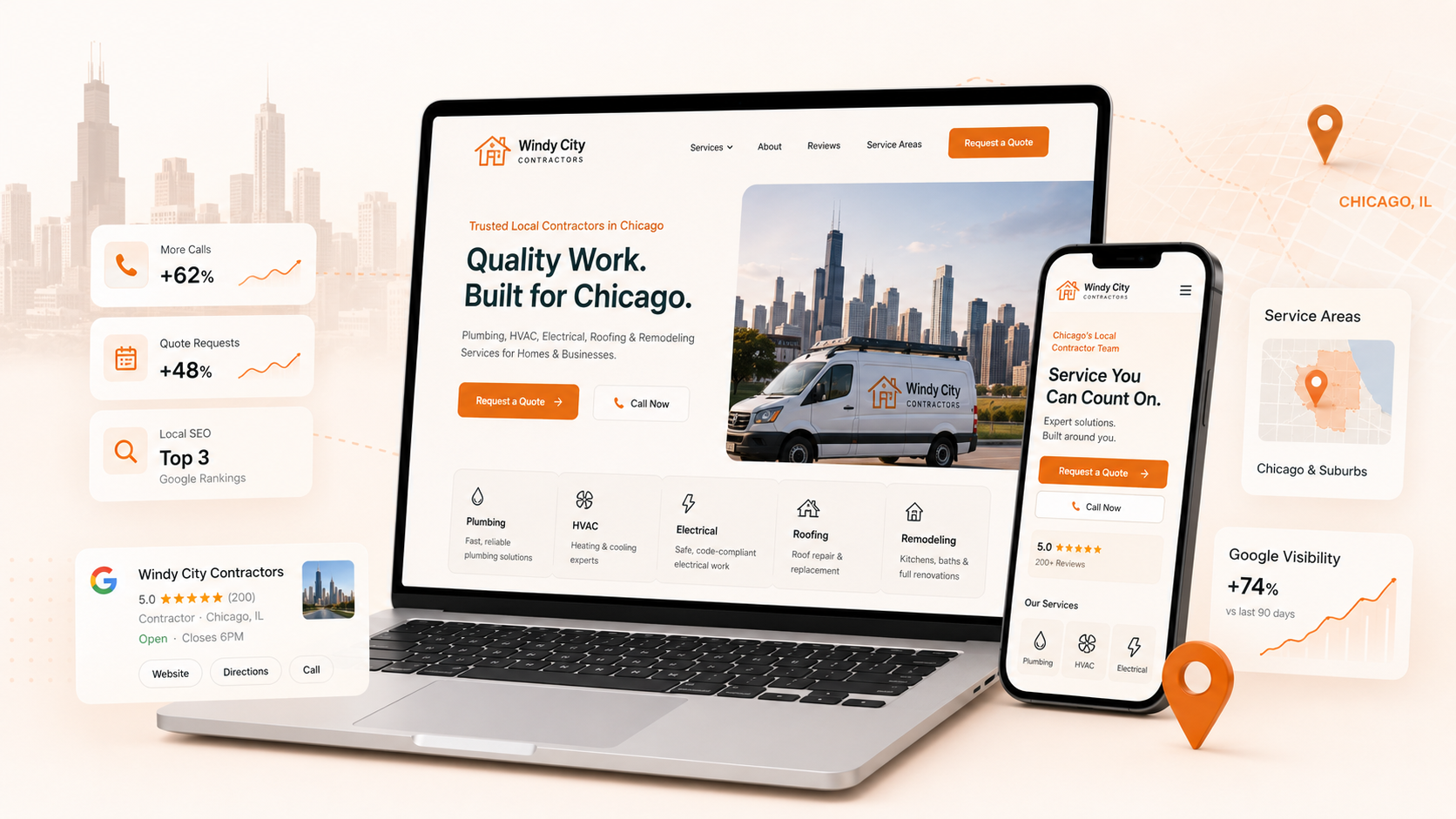
Chicago has millions of residents, over a million households, and constant construction and repair activity. For local contractors, a strong website can help capture more of that demand through local SEO, trust signals, and better lead capture.
For a local contractor, a website is not just a digital business card. It can be the difference between a customer calling you, calling a competitor, or never reaching out at all.
This matters even more in a market like Chicago.
Chicago has millions of residents, over a million households, dense neighborhoods, older properties, new construction, renovations, emergency repairs, and a constant need for local services. Plumbers, electricians, roofers, HVAC companies, remodelers, painters, landscapers, flooring companies, and handyman services are not competing in a quiet market. They are competing in one of the busiest local service markets in the country.
The question is not whether people in Chicago need contractors. They clearly do.
The real question is: when they search online, does your business look like the one they should trust?
Chicago Is a Large Contractor Market
According to U.S. Census data, Chicago had about 2.72 million residents in 2024 and more than 1.16 million households from 2020 to 2024. The city also had a 46.0% owner-occupied housing rate, with a median owner-occupied home value of $334,100.
For contractors, those numbers matter.
A large city with over a million households creates constant demand for repair, maintenance, upgrades, remodeling, emergency work, and property improvement. Even renters can influence contractor demand through landlords, property managers, apartment buildings, commercial spaces, and maintenance requests.
Chicago is also not a city where every home and building is new. Older properties, seasonal weather, heavy use, and dense neighborhoods create ongoing needs for plumbing, electrical, roofing, HVAC, remodeling, and general repair work.
The demand already exists. A website helps contractors capture more of it.
The City Shows Constant Construction and Repair Activity
The City of Chicago’s building permit data goes back to 2006 and is updated through the city’s open data portal. The city notes that each year’s permit dataset can contain more than 65,000 records.
That does not include every small repair or every informal service call, but it shows how active the construction and property improvement market is.
Permits cover areas like new construction, renovation, electrical work, demolition, signs, porches, extensions, and other work that requires city approval. In other words, there is constant movement in the local building and contractor space.
For a contractor, that means competition is not just about who does the work best. It is also about who gets found first, who looks trustworthy online, and who makes it easiest for the customer to take action.
Customers Search Before They Call
Most contractor customers do not want to spend hours researching. They want to solve a problem.
A homeowner with a leak wants a plumber. A property owner with no heat wants HVAC service. Someone planning a remodel wants to know who looks legitimate. A business owner with an electrical issue wants a contractor who seems reliable.
Before they call, they usually check a few things:
- Does this contractor serve my area?
- Do they handle the service I need?
- Do they look professional?
- Do they have reviews?
- Can I call or request a quote quickly?
- Do they seem like someone I can trust in my home or building?
A good website answers those questions fast. A weak website creates doubt.
Online Trust Is Part of the Buying Process
This is where a lot of contractors underestimate the website.
A potential customer may find you on Google Maps, through a referral, on Facebook, from a truck, or from a yard sign. But once they search your name, your online presence has to support the sale.
BrightLocal’s 2025 consumer review research found that only 4% of consumers say they never read online business reviews. Their 2024 research also found that Google remained the most-used platform for reading online reviews, with 81% of consumers using it for that purpose.
That means online trust is not optional anymore.
For contractors, the website and Google Business Profile work together. Reviews build confidence, but the website gives people the details they need to act. If your Google profile looks decent but your website looks outdated, confusing, or unfinished, the customer may hesitate.
That hesitation is where leads disappear.
Where Contractor Websites Lose Leads
Many contractor websites do not fail because the company is bad. They fail because the path to contact is unclear.
Common problems include:
- The phone number is hard to find on mobile
- There is no clear “Request a Quote” button
- The site loads slowly
- Services are too vague
- There are no service-area pages
- Emergency services are not highlighted
- There are no reviews or trust signals on the site
- The contact form asks too much or feels outdated
- The website does not explain what happens after submitting a request
- The site looks unfinished compared to competitors
These problems sound small, but contractor leads can be valuable. Losing even a few serious calls per month can cost more than the website itself.
A customer with an urgent plumbing, electrical, roofing, or HVAC issue is usually ready to act. If they cannot figure out how to reach you quickly, they will move to the next contractor.
The Biggest Website Boost Comes From Conversion
A better website does not magically create demand.
Chicago already has demand.
The real boost comes from conversion: turning more of the people who already find you into calls, form submissions, quote requests, and booked jobs.
For contractors, conversion usually comes from a few key improvements:
- Clear call buttons
- Fast mobile layout
- Service-specific pages
- Strong local location signals
- Simple quote request forms
- Visible reviews and trust signals
- Emergency service messaging
- Photo proof of real work
- Tracking for calls and forms
- Better landing pages for Google Ads
If 100 people visit a contractor’s website and only 2 contact the business, improving that number to 4 or 5 can make a serious difference. The traffic did not change. The website simply did a better job turning visitors into leads.
That is why contractors should not think of a website as just design. It is part of the sales system.
Local SEO Matters for Chicago Contractors
Chicago is competitive, and “contractor near me” searches are not enough.
A contractor website should be structured around the way customers actually search. That usually means combining services with locations.
For example:
- Emergency plumber in Chicago
- Drain cleaning in Des Plaines
- Roof repair in Schaumburg
- Electrician in Arlington Heights
- HVAC repair in Oak Park
- Kitchen remodeling in Naperville
- Water heater replacement in Evanston
- Commercial plumbing in Chicago suburbs
A strong contractor website should make it clear what services the business offers and where it provides them.
That does not mean stuffing city names everywhere. It means building useful pages that help customers understand the service, the area covered, and the next step.
Good local SEO usually includes:
- Service pages for core work
- Location or service-area pages
- Clear page titles and headings
- Google Business Profile consistency
- Reviews and reputation signals
- Internal links between related services
- Fast mobile performance
- Real photos and project examples
- Clear contact and quote request options
The goal is not just traffic. The goal is qualified local traffic that can turn into real jobs.
A Website Makes Google Ads Work Better
Many contractors run or consider running Google Ads.
But if an ad sends people to a weak website, the business may pay for clicks that do not convert.
This is especially important for urgent services. If someone clicks an ad for emergency plumbing, they should not land on a generic homepage with no clear emergency message. They should land on a page that quickly confirms:
- Yes, we handle this service.
- Yes, we serve this area.
- Yes, you can call now.
- Yes, you can request help quickly.
- Yes, this business looks trustworthy.
A better website can make ad traffic more effective because it gives visitors a clearer reason to contact the company after the click.
For contractors, the website is not separate from advertising. It is where the advertising either turns into money or gets wasted.
Social Media Is Not Enough
Some contractors rely on Facebook, Instagram, referrals, or Google Business Profile alone.
Those channels help, but they should not replace a website.
Social media is good for showing activity, photos, before-and-after work, and personality. But it is not always good at organizing services, locations, quote forms, emergency details, reviews, and contact information in one clean place.
A website gives the business a stable home online.
Every other channel can point to it:
- Google Business Profile
- Business cards
- Trucks
- Yard signs
- Referrals
- Google Ads
- Local directories
When someone wants to verify the business, the website should make the company look real, established, and easy to contact.
What a Chicago Contractor Website Should Include
A strong contractor website does not need to be complicated. It needs to be clear, fast, and built around local leads.
At minimum, a contractor website should include:
- A strong homepage
- Clear list of services
- Individual pages for major services
- Service area information
- Click-to-call buttons
- Request a quote form
- Emergency call-to-action if relevant
- Reviews or testimonials
- Real project photos
- Licensing, insurance, or experience details if available
- Google Maps or local business information
- Mobile-friendly design
- Basic SEO structure
- Call and form tracking
The best websites remove uncertainty.
Customers should not have to guess what you do, where you work, whether you are available, or how to contact you.
So, How Much Can a Website Actually Help?
The honest answer is: it depends on the contractor.
A website will not fix bad service, no reviews, weak follow-up, or poor pricing. But for a legitimate contractor in a competitive market like Chicago, a better website can create a serious advantage.
It can help more customers find you. It can make your business look more trustworthy. It can turn more visitors into calls. It can support Google Ads. It can improve local SEO. It can reduce missed leads. It can give referrals a professional place to land. It can make your business look established even before the first conversation.
For contractors, that is the real value.
Not just “having a website.”
Having a website that works.
Final Thoughts
Chicago is a large, competitive, and active market for local contractors. With millions of residents, over a million households, constant building activity, and customers relying heavily on online reviews and Google searches, contractors cannot afford to treat their website like an afterthought.
A strong website does not replace good work. It helps more people discover that good work, trust it faster, and contact the business with less friction.
At Aevora Studio, we help local service businesses build websites that are designed around real customer behavior: clear services, local SEO, mobile-friendly design, lead capture, and simple paths to calls or quote requests.
If your contractor website is outdated, hard to use, or not bringing in enough leads, the issue may not be demand. The demand is already there.
The website may simply not be capturing it.